

OCD Scriptathon 2017: A Group Scripting Experience
What: OCD Scriptathon 2017, A Group Scripting Experience Where: Our office! Located at 11380 Prosperity Farms Road, Ste 209A, Palm Beach Gardens, Florida 33410 When: Tuesday, April 11, 2017 from 8:00 PM – Until It Ends If you’ve ever practiced imaginal exposure, you’ve learned that having freaky thoughts on purpose can actually help you fight your OCD. Please join us for Scriptathon 2017, a group scripting experience. This is an opportunity to put your worst fears and most horrific thoughts on display for the world to see. Feel free to incorporate death, blasphemy, sexual thoughts, or any other distressing theme(s) that your OCD uses against you. This exposure experience is not for the faint of heart, and attendees should expect to hear things that might be disturbing or distressing. Also, please note that given the sensitive nature of the topics discussed, this event is for adults-only....
Read More
OCD and Uncertainty
These are difficult times. Lately, it seems, each week brings with it something truly horrifying. A shooting or an act of terrorism, a hate crime committed against an individual, a disease that affects the unborn. You can hardly turn on the news without hearing about something that incites fear. Yet… We get up every day and go about our normal lives. We get in the car, we drive to work, we come home to our families. We live as if we are untouchable. Technically, we’re not, but we’re often happiest when we live as if we are. Some of us do this easily. The awareness of our own fragility doesn’t linger. Others of us are tortured by possibilities. What if this happens to me? What if this happens to someone I love? OCD brings with it superhuman attention to...
Read More
OCD Treatment: Back to Basics
In previous posts, I have discussed various aspects of the “OCD Cycle,” but it never hurts to have a quick refresher. After all, understanding how OCD works can help you see through its lies and help mobilize you to stand up and challenge it. What is OCD, and how does OCD treatment work? OCD has two mains parts: obsessions and compulsions. We’ll talk about the obsessions first. Obsessions are unwanted thoughts, impulses, or images that intrude into your awareness, and cause significant anxiety or distress. Thoughts include such examples as, “What if I get sick?”, “What if I secretly want to harm my loved ones?“, “What if I just got sexually aroused by that child?“, and “What if I forgot to lock my front door and someone breaks in?“. Impulses are experienced as urges to commit actions that you...
Read More
Common Misconceptions About Anxiety & OCD Treatment
People new to OCD treatment often walk through the door with more than a few misconceptions. Here are some common ones: Misconception 1: Anxiety is bad. Actually, anxiety is a normal, functional, biologically-based phenomenon that every person is capable of experiencing. The only people who are truly anxiety-free are dead people. The rest of us (the living ones, at least) will find that anxiety will be a part of our lives, at least to some extent. Some anxiety is good and can be helpful. For example, it’s probably good to have some anxiety when you’re studying for a test. This anxiety can help motivate you to prepare sufficiently. Similarly, it’s probably good to have some anxiety about doing dangerous things, such as driving too fast — this anxiety might just save your life. Of course, not all anxiety is...
Read More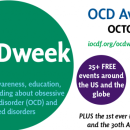
OCD Awareness Week 2016
It’s #OCDWEEK! Help raise awareness and understanding about obsessive compulsive disorder (OCD) and related disorders. Welcome to #OCDWEEK 2016, a week organized by IOCDF to help raise awareness about OCD and related conditions! If you visit IOCDF’s website, you’ll find information about local and online programs and events designed to help increase the general public’s understanding of OCD. When I started this blog a few years ago, the internet was awash in misinformation about the nature of OCD. OCD was (more often than not) described in oversimplified terms, and the popular media largely mischaracterized OCD as a disorder defined primarily on the basis of excessive washing or checking behaviors. If you didn’t fit this mold, it was implied that you didn’t have OCD. I was hoping that, through my writing, I might be able to address some of these...
Read More
Group Therapy for OCD: Power in Numbers
Group Therapy for OCD Wow. Our first OCD treatment group met yesterday, and IMHO, it was an incredible experience. Thank you to all who attended and showed such courage in standing up to their OCD. I was reminded anew how group therapy for OCD is so different than individual therapy. OCD wants to separate us from others, to shame us, to make us feel hopeless, defective, and guilty… It wants us to define ourselves on the basis of things we can’t control and forget that we are not our thoughts. After all, that’s how it maintains its power over us. Although there is great vulnerability in putting your thoughts out there and saying them aloud in front of others, by doing so, we defy our OCD. OCD lost a few battles yesterday. Let’s keep this war going. For those...
Read MoreFollow Me


Or Call (561) 444-8040
CPBS – South Florida (Palm Beach County)

Outpatient & Intensive Treatment Programs for Adults, Kids, & Teens
Upcoming Events
Get Email Alerts
Meet the Author

Dr. Steven Seay is a licensed psychologist in Florida & Missouri. He is the Director of the Center for Psychological & Behavioral Science and provides treatment & therapy throughout South Florida, including Palm Beach Gardens, Jupiter, West Palm Beach, Boca Raton, Boynton Beach, Fort Lauderdale, & Miami.
Read more...